Showing posts with label honda. Show all posts
Wednesday, February 20, 2013
2013 Honda Fit
The 2013 Honda Fit offers ample passenger and cargo space for such a small car, but reviewers wish it had a more powerful engine, more optional features and a quieter cabin. An above-average reliability score helps the Fit secure a spot at the top of its class.
While the Honda Fit hatchback’s four-cylinder engine isn’t powerful, reviewers still say the Fit is pretty fun to drive for a subcompact, thanks to its standard manual transmission and nimble handling. With the automatic transmission, the Fit averages up to 28/35 mpg city/highway, and although those ratings aren’t the highest in the class, they’re still good for a hatchback with as much cargo space as the Fit. Still, some members of the automotive press mention that competitors have quieter interiors, better brakes, higher fuel economy ratings and more powerful engines. Some car reviewers may think that the 2013 Fit falters for its performance, but the Fit trumps many of its better-performing competitors, like the Volkswagen Golf and Mazda2, with above-average reliability.
Despite these criticisms, reviewers note that no competitor can match the Honda Fit’s interior space. The five-seat cabin offers front and rear seats with plenty of space for adults, cargo space that rivals some affordable compact SUVs and a class-exclusive Magic Seat that allows you to arrange the passenger seats to accommodate cargo like a tall plant or bicycle. The Honda Fit has a standard USB port and optional Bluetooth and navigation, which are typical features for the class, but some rivals offer these as well as infotainment systems and optional safety equipment like blind-spot monitoring.
"Well, its many new competitors outdo the Fit in a number of different ways. The Chevrolet Sonic, Ford Fiesta, Hyundai Accent and Kia Rio offer a more comfortable ride on the road, stronger brakes, more efficient and/or powerful engines, and quieter, higher-quality interiors." -- Edmunds
"Ride, acceleration and handling: The new Fit gets top marks in all three categories. It is one of the most enjoyable small cars on the road." -- The Washington Post (2009)
"This is a subcompact in name and exterior size only; it's really a small wagon that challenges some compact SUVs for room while getting significantly better fuel economy. Fit deserves a top spot on your shopping list, but our nod goes to the cheaper, yet no less versatile, Base model." -- Consumer Guide (2012)
Other Cars to Consider
The Honda Fit doesn’t offer many optional features, but the Ford Focus has a lot of interior tech and safety features to choose from. Focus can come equipped with one of two infotainment systems, as well as a safety feature called MyKey that helps parents set limits on new drivers. Though the Focus doesn’t have as much cargo space as the Fit, it has good fuel economy ratings, an optional turbocharged engine and sedan and hatchback body styles.
If you want a hatchback with outstanding performance for the class, consider the Mazda3. Reviewers are impressed with its powerful engines and responsive steering, even on the base model. Keep in mind, though, that test drivers say the Mazda3’s second-row seats are cramped, and it doesn’t have as much cargo space as the Honda Fit.
The Fit is available in three trims: Base, Sport and Sport with Navigation. All models have a four-cylinder engine, and a five-speed manual transmission is standard. An automatic, which can be paired with paddle shifters, is optional. The Honda Fit hasn’t changed much in the past few years, so this overview uses research and reviewers from the 2009 to 2013 model years.
Thursday, February 7, 2013
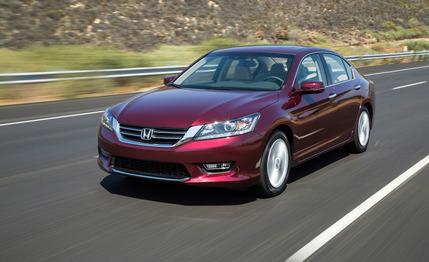
Honda Accord Sedan
There were low points in the past few years when we doubted Honda, but Big H might be on its way back. The new, ninth-generation Accord is a convincing reminder of the company’s core values and—considering all Honda has been through, including an earthquake that smashed its Tochigi R&D center and floods in Thailand that crimped production—a triumphant return to form.
This latest Accord is 3.5 inches shorter bumper to bumper and 0.9 inch tighter at the wheelbase than its fleshy predecessor. Yet once again, Honda conducts a master class in packaging. Against its porcine predecessor, the 2013 car’s cabin dimensions vary hardly at all. The Accord still feels like one of the biggest cars in the segment, with two roomy and extra-comfortable front buckets and a back bench you and two friends can stretch out on. Moreover, the capacious trunk is even larger, maximum volume having increased by over one cubic foot.
The overhauled DOHC 2.4-liter four falls under the somewhat nonsensical Earth Dreams marketing slogan; more important, however, is that it represents Honda’s first whack at gasoline direct injection for the North American market. Your only automatic alternative to the six-speed manual with this engine is a Honda-built continuously variable transmission (CVT) called the G-Design Shift (Honda’s committee for cutesy names has been working overtime).
The 2.4-liter is quieter at idle than some other direct-injection engines with their clattering high-pressure injectors, particularly Hyundai’s. And the Honda likes to rev, sounding healthy and full throated at its 6400-rpm power peak. But it’s the CVT’s tuning that makes the Accord feel fleet. The typical rubber-band delay has been minimized, and the throttle responds curtly when you ask for acceleration (although sometimes with some audible transmission whine at high revs). In mountain snakers as well as on city streets, the CVT works so efficiently that it all but disappears, and you never notice the lack of a manual control. Of course, we’d prefer the optional six-speed stick, with its tightly spaced gates and short throws—but, finally, a belt-and-pulley transmission we can live with!
Somewhere between 15 and 20 percent of Accord buyers opt for a V-6, and for them, the 3.5-liter goes up slightly in horsepower to 278. But the news with this engine is its lighter weight due to items such as plastic cam covers and work on the Variable Cylinder Management system that increases the time the engine runs on three cylinders. In motion, the cylinder cutout is completely transparent, and the V-6 does what it’s supposed to: provide more sophisticated and effortless propulsion.
Wednesday, January 30, 2013
Honda Accord V-6 coupe
It’s all too easy to dismiss coupes based on family sedans as conformity dressed up as rebellion. Simply putting two doors where once there were four does not create a sporty car. Starting with one of the most athletic and powerful family sedans and then turning it into a coupe? Well, that just might work.
The 10Best-winning 2013 Accord coupe feels a lot like its four-door sibling. That’s not a bad thing. All Accords share the same delicate wheel control and supple yet balanced ride. It’s a nimble and playful car that more than makes good on the promise of its rakish styling. Where the coupe differs from the sedan is in its size; this is not a family-style meal. Its overall length is 2.2 inches shorter than the sedan, and two inches have been clipped out of the wheelbase.
Carting around less car is a good start on the road to sportiness. The Accord V-6 coupe we tested weighed in at 3399 pounds. The manual gearbox isn’t available in the Accord V-6 sedan, but an automatic version we tested recently tipped the scales at 3552 pounds.
What really makes the Accord feel light is the 278-hp, 3.5-liter V-6. Careful chassis tuning keeps the coupe on an even keel, but the powerful V-6 under the hood dominates the experience. Driven normally, excessive wheelspin and torque steer are kept in line. Revving the engine and dumping the clutch, however, will result in tire smoke and some steering-wheel tug. A hard launch will bring a 0-to-60 time of 5.6 seconds; a quarter-mile time of 14.0 seconds at 103 mph is possible. Forgoing the brutal launch, as we do with our 5-to-60-mph rolling start, adds only 0.4 second to the 60-mph sprint.
Manual fans will delight in the mechanical feel of the Accord’s shifter. Quick shifts and nicely placed pedals make the stick a purist’s delight. Buyers who prefer an automatic get a new six-speed and better fuel economy than the manual version (21/32 versus 18/28). We’d gladly live with the fuel-economy penalty to enjoy the involvement and precision of the manual transmission.
As you’d expect, rear-seat space is not a priority here. The new coupe has actually lost a few cubic feet of rear-seat space compared with its predecessor. The front seats are as comfortable as the sedan’s, though, especially when the V-6 is pressing you firmly into them. Rearward visibility is more restricted than in the sedan, a victim of styling, but our loaded V-6 model came with Honda’s new blind-spot camera that displays the right-side blind spot on the dashboard screen.
At the end of its life, the sedan outsold the previous Accord coupe by a factor of 10 to one. Yet Honda continues to offer the Accord coupe. It’s not a rational decision, but neither is the 278-hp V-6. We’re certainly glad both the coupe and the optional V-6 exist. Sporty, mid-size coupes are getting harder and harder to find. Nissan has pared back its Altima coupe offerings to one four-cylinder with an efficiency-over-fun CVT. Hyundai offers the sporty-looking rear-wheel-drive Genesis coupe in four-cylinder turbo and V-6 forms, but that car lacks Honda levels of refinement. There are several six-pot mid-size coupes available from luxury brands—the Cadillac CTS, the BMW 128i, the Infiniti G37, and the Mercedes C250 among them—but they routinely cost many thousands more.So if you’re looking for a popularly priced mid-size coupe with six-cylinder power, Honda levels of refinement, and, rarer still, a slick-shifting manual gearbox, your shopping list is as short as it possibly can be.
Wednesday, January 9, 2013
Superior Crash Protection
IIHS Picks 13 Midsize Sedans with "Superior Crash Protection" for 2013
The 2013 Honda Accord is one of the 13 midsize sedans to receive the Top Safety Pick+ award.
Last month, the Insurance Institute for Highway Safety awarded 13 midsize sedans to its new Top Safety Pick+. In addition to receiving scores of "Good" or "Acceptable" in IIHS’s new small overlap frontal-impact crash test, the 13 vehicles chosen as Top Safety Pick+ winners received top scores of "Good" in moderate overlap frontal impact, side impact, rear impact and rollover crash tests.
The new small overlap frontal crash test, which was announced in August, simulates a front corner of a car crashing into something like a tree or utility pole traveling at about 40 mph. Vehicles are rated "Good", "Acceptable", "Marginal" or "Poor" in the new test. In December, the IIHS tested 18 midsize car models using the new scenario. An IIHS study conducted in 2009 found that the small overlap frontal impact crashes accounted for a quarter of serious or fatal accidents to front seat occupants.
The 13 midsize models that received the Top Safety Pick Plus are:
Acura TL
Dodge Avenger
Chrysler 200 sedan
Ford Fusion built after Dec. 2012
Honda Accord sedan and coupe
Kia Optima
Nissan Altima sedan built after Nov. 2012
Subaru Legacy built after Aug. 2012
Subaru Outback built after Aug. 2012
Suzuki Kizashi
Volkswagen Passat built after Oct. 2012
Volvo S60
AutoWeek reports that only midsize sedans have been tested thus far, and IIHS plans to announce more Top Safety Pick Plus winners as they test more vehicles. By spring, the IIHS expects to have results for compact SUVs.
Saturday, October 27, 2012
Honda CR-Z
Honda
promotes the 2012 CR-Z as a sports car and a hybrid. The manual starts
at $19,695, and the automatic continuously variable transmission, or
CVT, starts at $20,345.
Under
the hood, you'll find a gas-electric hybrid system with a 16-valve,
1.5-liter i-VTEC four-cylinder engine pumping 122 horsepower. It comes
standard with a six-speed manual transmission, which Honda claims is a
first on a hybrid vehicle. The manual will get you very decent fuel
economy -- 31 mpg city, 37 mpg highway and 34 mpg combined.
But
with the automatic continuously variable transmission, you'll save even
more gas, getting 35 mpg city, 39 mpg highway and 37 mpg combined.
According to Edmunds testing, you'll only need 8.8 seconds to hit 60
mph. With the manual transmission, the CVT loses some speed, doing the
sprint in 9.2 seconds. To customize your fuel consumption, the
three-mode drive system allows you to choose sport, normal or eco mode
for your drive.
Safety
is on your side with standards such as antilock brakes, vehicle
stability assistance, electronic brake distribution and six air bags.
Subscribe to:
Posts (Atom)